- Home
- Conical Flask
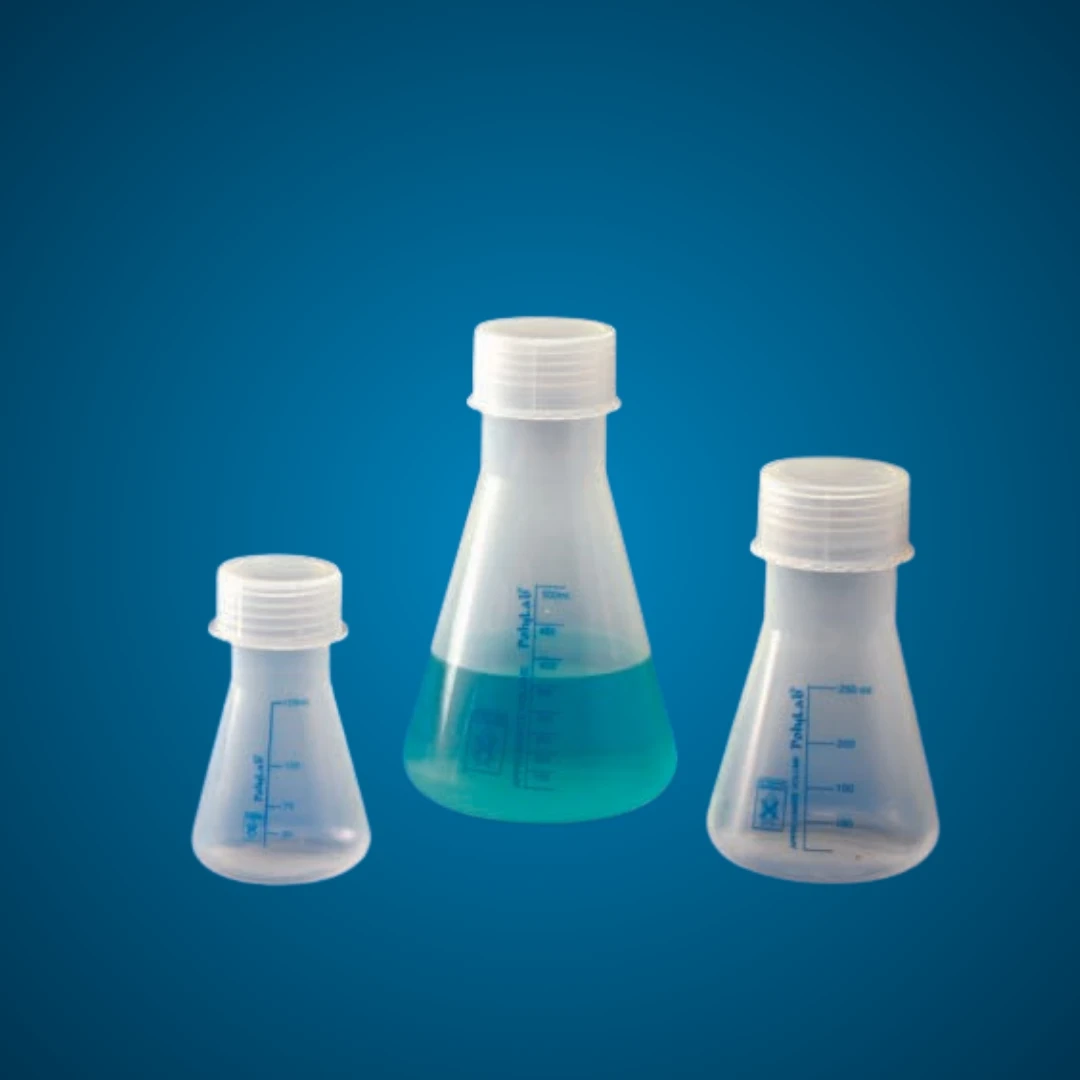
Material : Polypropylene
HSN Code : 39233090
Polylab is a Top rated, Best Manufacturer & Supplier of high-quality laboratory glassware and plasticware, offering precision-designed Conical Flasks that are widely used for mixing, heating, and storing chemical solutions in laboratory environments. These flasks are an essential part of scientific experiments in research laboratories, pharmaceutical industries, educational institutions, and industrial testing facilities where accurate measurement and safe handling of liquids are required.
The Conical Flask from Polylab is manufactured using superior-grade, heat-resistant, and chemically stable material that ensures excellent durability and safe performance under varying laboratory conditions. Its strong construction allows it to withstand temperature changes and chemical reactions without affecting structural integrity, making it highly dependable for routine and advanced laboratory applications.
Designed with a narrow neck and wide base structure, the flask provides excellent stability during mixing and reduces the risk of spillage. The carefully engineered shape supports efficient swirling of liquids, making it ideal for titration, sample preparation, and chemical reactions. Its smooth inner surface ensures easy cleaning and prevents residue buildup after use.
Code | Particulars | Packing |
|---|---|---|
38101 | 100 ml | 12 Pcs |
38102 | 250 ml | 12 Pcs |
38103 | 500 ml | 12 Pcs |
As a Top rated Manufacturer and Supplier – Polylab, these Conical Flasks are trusted for their accuracy, durability, and consistent performance. They are widely used in professional laboratories where precision, safety, and reliability are essential for scientific work.
Chemical Laboratories – Used for preparing and mixing chemical solutions.
Titration Processes – Ideal for accurate volumetric analysis experiments.
Research Institutions – Used in experimental studies and chemical reactions.
Educational Labs – Commonly used in school and college science practicals.
Pharmaceutical Testing – Applied in formulation and solution preparation processes.
Strong Heat Resistant Body – Designed to withstand heating applications without deformation or damage.
Chemical Stable Material – Resistant to a wide range of laboratory chemicals and reagents.
Stable Base Design – Ensures firm placement on laboratory surfaces during experiments.
Easy Swirling Structure – Ideal shape for smooth mixing and reaction processes.
Smooth Inner Finish – Allows easy cleaning and prevents chemical residue accumulation.
Top Rated Manufacturer – Polylab – Known for delivering reliable and high-performance laboratory products.
Best Quality Materials – Manufactured using carefully selected, laboratory-grade raw materials.
Safe Laboratory Usage – Designed for secure handling during experiments and testing.
Consistent Performance – Ensures accurate and dependable results in every application.
Trusted Supplier Network – Widely preferred by laboratories, institutes, and industries across India
Polypropylene is translucent rather than transparent like glass. This means that while light passes through and you can clearly see contents, liquid levels, and color changes, the material has a slight natural haze compared to the complete clarity of glass. The trade-off is that polypropylene offers significant advantages: it is virtually unbreakable, approximately 50% lighter than glass, provides excellent chemical resistance, and is fully autoclavable, making it a safer and more practical choice for many laboratory applications where absolute optical clarity is not critical.
Proper autoclaving procedure is essential for maintaining the integrity of these flasks. Before autoclaving, you must loosen the screw cap by at least one full turn to disengage the threads. This allows steam to enter the flask freely, ensuring complete sterilization and preventing pressure buildup inside the flask during the cycle. Failure to loosen the cap can result in pressure differentials that may cause deformation, cracking, or implosion. After the autoclave cycle completes and the flask has cooled sufficiently, you can tighten the cap to maintain sterility during storage.
Yes, these flasks with their leakproof screw caps are excellent for use on orbital shakers and incubator shakers. The secure cap prevents liquid escape during agitation, while the rigid polypropylene construction maintains its shape under shaking conditions. The classic conical design promotes efficient mixing and aeration. For optimal performance, ensure the cap is properly tightened before shaking, and always follow your shaker manufacturer guidelines for flask capacity and speed settings.
Polypropylene exhibits excellent temperature resistance across a broad range. These flasks can be safely used for storage in standard laboratory refrigerators (4°C) and freezers down to -80°C without becoming brittle or cracking. They withstand repeated autoclaving at 121°C (250°F) for sterilization. However, they are not designed for direct flame exposure or use on hot plates, as temperatures above 135°C may cause deformation. This wide temperature range makes them suitable for diverse applications from cryogenic storage to sterile culture work.
The approximate dimensions for each size are as follows:
100 ml Flask: Overall Height 105 mm, Base Diameter 65 mm, Mouth Opening 30 mm
250 ml Flask: Overall Height 145 mm, Base Diameter 85 mm, Mouth Opening 35 mm
500 ml Flask: Overall Height 180 mm, Base Diameter 105 mm, Mouth Opening 40 mm
These dimensions may have minor manufacturing tolerances. For applications requiring precise dimensional specifications, please contact our technical support team for detailed engineering drawings.
Polypropylene offers excellent resistance to a wide range of laboratory chemicals including: dilute and concentrated acids (except strong oxidizing acids like concentrated sulfuric and nitric), dilute and concentrated bases, alcohols, aldehydes, esters, and many aqueous solutions. However, polypropylene can be attacked by some organic solvents including aromatic hydrocarbons (toluene, xylene), chlorinated solvents (chloroform, dichloromethane), and some ketones. For applications involving organic solvents or aggressive chemicals, we recommend consulting our comprehensive chemical resistance chart or contacting our technical support team for specific compatibility guidance.
No, these conical flasks are not designed or validated for centrifugation. They are intended for general laboratory applications including mixing, storage, autoclaving, and shaking. Centrifugation generates significant centrifugal forces that these flasks are not engineered to withstand. For centrifugation applications, please use appropriate centrifuge tubes, bottles, or specialized centrifuge containers that are specifically designed and certified to handle the forces generated during centrifugation.
For routine cleaning, wash the flasks with mild laboratory detergent and warm water using a soft brush if needed. Avoid abrasive cleaners or scrubbers that could scratch the surface and compromise clarity. Rinse thoroughly multiple times with tap water followed by a final rinse with distilled or deionized water. For sterile applications, autoclaving is the recommended sterilization method. For stubborn residues or protein deposits, enzymatic cleaners or soaking in appropriate cleaning solutions may be used. Always ensure flasks are completely dry before storage to prevent microbial growth.
Yes, these flasks with their leakproof screw caps are excellent for long-term storage of liquid samples, reagents, and solutions. The secure seal prevents evaporation and contamination, while the chemically resistant polypropylene ensures sample integrity over extended periods. For long-term storage, especially in freezers, we recommend using appropriate labeling and ensuring caps are tightly sealed. For light-sensitive materials, these natural polypropylene flasks do not provide UV protection, so storage in opaque containers or in the dark is recommended.
PolyLab offers a comprehensive range of high-quality plastic laboratory ware designed for accuracy, durability, and everyday laboratory applications across education, research, healthcare, and industrial sectors.
Copyright © 2026 PolyLab, All Rights Reserved.